
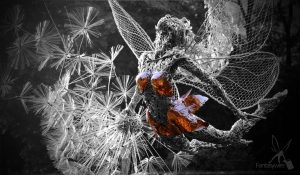
The first time you look at one of UK based artist Robin Wright’s wire fairy sculptures, all of your whimsical childhood dreams will come rushing back. Silver strands dip in, out and around the figures to create intricately woven fairies that come to life with wings, blue bell hats or hair waving in the wind. Woven with intense passion, it’s clear that a part of Robin goes into each piece.

The artist
Robin is the son of an engineer and spent 17 years working in the copper or nonferrous metal industry, rising from maintenance fitter through various management roles to become a project engineer. From there he moved on to spend 20 years in software design for the industry, which is still his day job.
He also mastered pencil drawing at a young age, another skill that he still dabbles in today, but has extended his medium to include the use of an iPad in recent years. The combination of Robin’s artistic and engineering talents has meant that he has created all manner of things, out of myriad materials throughout his life. He has also experimented with the creation of copper and brass ornaments, turned wooden chess pieces and built a rocking horse.
The artist’s interest in 3D sculpting was as a result of numerous trips to the beach with his children, where he would fashion elaborate sandcastles. As his children grew, Robin retained his love of 3D sculptures and would draw crowds as he worked on pieces while on beach holidays.
The beginning
In 2009, Robin and his wife moved to a nature reserve and he was confronted with an overwhelming amount of space and new art materials. He started doing large wooden carvings, working tirelessly to create these with a chainsaw and a chisel, but wood (like sand) has material constraints that limited his technique; sand could not support outstretched limbs and wood ran the risk of drying out, losing fragile parts as it did.
It was at this time that Robin stumbled upon wire sculpting –completely by accident. He received a camera for Christmas that year and while practicing photography in the woods, he took a photo of the sun streaming through the trees onto a group of moss-covered rocks. It was only later when he was browsing through the photos that he noticed what looked like fairy in the top left corner of the image.
Sure that it was an illusion, like seeing a rabbit shape in the clouds; he let the fairy slip from his mind. It was only in early 2010, when Robin was mending a wire fence; busy bundling up some wire scraps to throw away that it occurred to him that fence wire was a more than suitable material to sculpt with. It was easy to bend, required no special treatment or expensive equipment and gave a permanently weather-proof result. Like a “metal clay”, it allowed him to add and remove features to and from his sculptures as he wished unlike sand or wood.
He started by creating a simple human figure and, inspired by his earlier photograph, created wings out of chicken coup mesh, the result was very raw, but as a proof of concept for wire as a material, Robin was hooked.

Fairy Tale
The first fairy that Robin created was named “Glance” and she incorporated all his initial designs including his first attempt at hair. The next fairy to be born was “Tree Hugger”, which was an installation in a nature reserve that Robin was granted permission to do by the Straffordshire Wildlife Trust.
The local people came to love “Tree Hugger” and the following year requested that Robin showcase some of his sculptures at the annual village festival.
Robin thought long and hard about a fairy that he could showcase that wouldn’t be able to be picked up and made off with, and so “The Thief” was made. He balanced her on a watering can that was filled with concrete so that she would not be stolen. “The Thief” is now the logo for his sculpture business, Fantasywire.
The Trentham Estate
As a once off attraction to promote the Straffordshire Wildlife Trust, Robin made a series of fairies to hide in the local woods for members of the local public to find, they loved it. So when Robin was asked to participate in the festival again the following year he pulled out all the stops and set up a larger fairy trail in the reserve where he lived. He handed out maps and images of the fairies so the children could tick them off as they found each one.
Then a stroke of luck occurred, Robin’s work was noticed by the marketing manager for the Trentham Estate and not long after he received an email entitled “We love your fairies”. The next day, all the fairies aside from his very early attempts were loaded and whisked away to Trentham.

Why dandelions
Robin had always wanted to create a dandelion sculpture with seeds blowing away all interconnected and having quite a substantial amount of wire sculpting experience under his belt he decided to give it a bash. He made a small dandelion and created a fairy to blow it, in the tradition of wishes, and the fairy/dandelion combination was born.
He was so impressed with his first dandelion that he decided to make much larger one and the first time someone saw it they asked if they could buy it.

Creating a fairy
Robin now sells his fairies and small DIY fairy kits for the more creative soul. After visiting the site of the installation and seeing the pose that the client has decided on, he does an initial sketch of the fairy and then converts it into a scale model. From there he starts to form the skeleton of the model, a strong steel rod is usually used as a mounting bracket and twisted wire, bent to match the fairy’s size, creates the rest of the skeleton.
Different sized wires, the first layer being the thickest, forming the skin and the last layer being the thinnest, to create the appearance of skin are wrapped in layers around the figure. Robin then adds the details, wings, a hat or a dandelion to perfect his fairy masterpieces. His signature, is the stone heart that he buries in the centre of each of his fairies, which can be engraved for an extra special touch.

Fame
Robin had always had a few enquiries a day about him selling his fairies, but when a woman who had snapped a picture of one of his sculptures in the Trentham Gardens shared the image on Facebook he in turn shared it, and within a day it had been shared over 1000 times. Robin shortly received a call from a landscape architect who wanted to include the image in a forum and another man shared it on Imugur and Reddit. The image went viral.
Robin describes what happened next as being surreal, as literally 1000s of emails poured in with enquiries about his work. While all the hype was still going on, Robin posted a video of his fairy weathervane “1 o’clock wish” on his Facebook page and in just a few days the video had been shared nearly 42 000 times and reached 3.5 million people.
As a result he received around 1000 requests to purchase the piece. The Fantasywire artist continues to bring his client’s fairy fantasies to life with his beautiful fairies, dancing with dandelions.
