If the definition of graffiti is simply the writing on the wall then it has travelled a long road from ancient worlds as inscriptions and drawings on sculptures and buildings. A fairly new movement in graffiti known as “street art” is forming a part of global discussions, as these interesting works often recapture the beauty of forgotten spaces, outside of just the “image” of the moment in question.
One set of hands involved in this movement belongs to Cape Town based street artist Faith 47. She began her training in graffiti at 17 under her great confidant wealz130 who took her painting train lines and freeways and taught her the ins and outs of the graffiti movement. Faith 47 has never studied art, and has been guided predominantly by her instincts and intuitions – the result? Her own unique style of captivating street art which has seen her dubbed a female Banksy by some. But Faith 47’s art has a voice all its own.

Perspective
Street art is a broad term that describes art found in a public space, from sticker to stencils, paste-ups and installations to more traditional graffiti. It expresses a rich spectrum of thoughts that draw in and captivate the viewer with its variety of themes and ideas, ranging from social and political awareness to intricate visual poetry. Today it is an art form that continues to gain momentum.
Though some may regard street art in its raw form as vandalism, its goal is not that primitive, the artists who perform it see it as a means to create something meaningful by beautifying run-down buildings or reclaiming forgotten spaces. Faith 47 nurtures forgotten spaces; she is interested in the architecture of neglect that sees worn down steps and dirtied corners hiding vagrants from the public eye. Small marks left behind by humanity like dirty hand marks or smoke-stained walls are her perfect canvases to her.
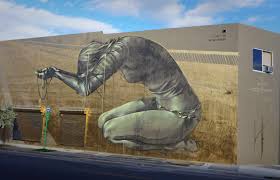
Street artists take the leap of bringing vibrancy, colour and fluidity into the harsh environments of everyday life. In Faith 47’s mind, public spaces should be used for the public to engage with each other, so she frames her works with the communities around them to create context for her art. She embraces that the art created on the streets is temporary and fragile, like human life.
Disintegrating buildings, old rusted gates and broken down factories are just some of the canvases she uses to express the delicacy of life and the fact that it is impossible to hold onto things. As a result her art is a journey, sometimes so lifelike it pops off the very walls and environments that host it.
 Visualise
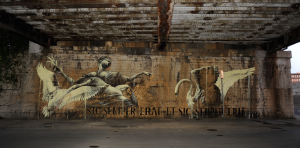
Situated in the Gaeta Cemetery in central Italy is a Faith 47 mural entitled “Will You Stay With Me? Until the Very End?” that was created for the Memorie Urban Festival. The mural, completed by the artist in two days, is an exquisite depiction of two swans that evokes emotion from all who see it. The piece traces and reflects upon the feelings of the families of the deceased and perhaps, the deceased themselves.
Political art in a gallery is one thing, but to paint your message on the street is another and takes courage. Faith 47 says creating art on the street lets the artist experience things that a studio artist cannot. In addition she says many interesting people have visited her while she is working and it’s an experience that is truly organic and inspiring, giving her inspiration through their presence.
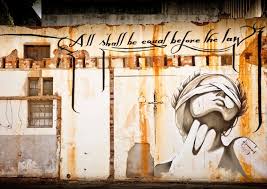
The Freedom Charter, 26 June 1995, is a historical document listing the desires of the people in the struggle against apartheid in South Africa. In 2010, Faith 47’s “The Freedom Charter” saw her using phrases from this document in her street art in Johannesburg and Cape Town to bring to life sentences from the document that she felt were still relevant in the country today.
Faith 47 took inspiration for this series from old political slogans and stencils that were used during the struggle against apartheid. “The people shall govern”, “The people shall share in the country’s wealth”, “All shall be equal before the law” and “The doors of learning shall be opened” are just some of the phrases she uses to expose that these promises have only been superficially met.
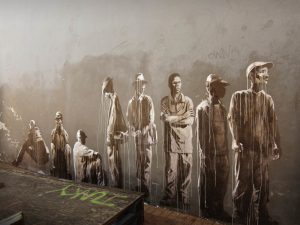
“The Long Wait”, a 2012 series of Faith 47’s street art in Johannesburg comments on one of the most turbulent times in South African history. Murals of people waiting are weaved in and around the city of Johannesburg, the aim of the works is to show that South Africans have been waiting for justice, wages, service delivery, jobs, assistance, an honest politician, depicting that the waiting has gone on for too long and much valuable time has been lost.
Transitions
The transition from street to studio sees the works inspired by the street being displayed indoors for a completely different audience. Faith 47 has work both on the streets and in galleries with projects and exhibitions in Europe, America, Australia, Germany, Italy and the UK to name a few, but describes street art as a socialist expression. She says that street art allows for real access to the general public instead of being hidden away, but adds that both spaces are necessary and have their own virtues and vices.
From around 2005 Faith 47 started forming connections with artists and people internationally which led her to her first solo exhibition “The Restless Debt of Third World Beauty” that was displayed in Berlin in 2008. The exhibition was an exploration into the South African landscape that delves into its beauty, strength, hardship and neglect.
Faith 47 gains inspiration from the pain and profundity of being a part of the human race. This thought is dotted through her first solo South African exhibition at the David Krut Gallery in Johannesburg in 2013. The intriguing installation “Fragments of a Burnt History” was composed of found objects and artworks created in Faith 47’s studio as well as a series of monotypes created in collaboration with the well-known David Krut Print Workshop.
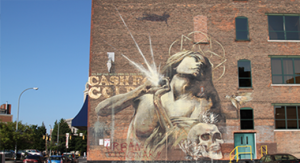
The exhibition was drawn from the artist’s personal experience of Johannesburg and the textures of the city were incorporated into the works, exhibiting the vibrancy and endless possibility of city life but also the harsh realities of everyday life. An “Exit” sign, a piece of corrugated iron, books, one of which is entitled “From Slavery to Freedom”, are just some of the objects that mingle among the artist’s pieces to bring the street and the studio together.
Faith 47 admits that she arrived at a point where she realised that humanity perpetually repeats its mistakes throughout history. Her work started to become more introspective, exploring the more fundamental aspects of what it means to human. In her recent work one feels that her work is a mirror, reflecting within us lingering notions of who we are.
